How to Remove Oil and Grease Stains from Work Uniforms
- Topic
- Uniform Sourcing
- Written
- Read
- 7 min read
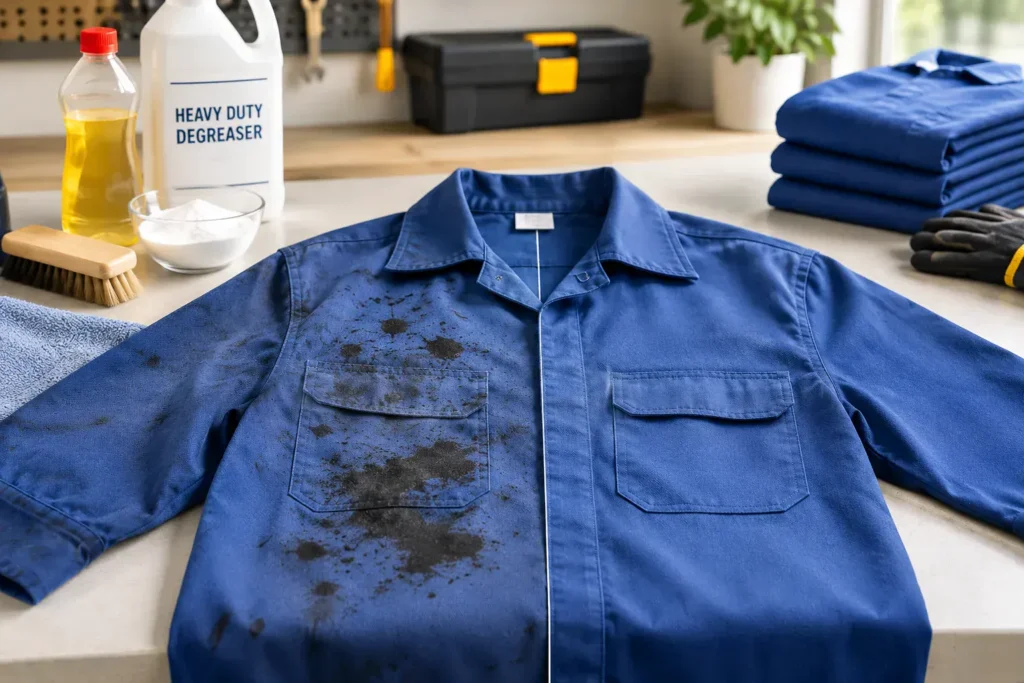
Someone gets hydraulic oil down the front of a coverall. The first thing almost everybody does is take it to a tap and run cold water over it.
That does nothing. Not very little. Nothing at all. Learning to remove oil stains from work clothes starts with understanding why, because the same instinct that fails at the tap is the one that ruins the garment an hour later.
Why water alone cannot remove oil stains from work clothes
Water is a polar molecule. Oil and grease are non-polar. Chemistry has a blunt rule about this, that like dissolves like, and it means water and oil have no mechanism for mixing. You can run a tap over a grease mark for an hour and the oil will sit exactly where it was.
Detergent is what bridges the gap. A surfactant molecule has two ends, one that bonds with water and one that bonds with oil. Enough of them surround an oil droplet, lift it off the fibre and carry it away in the wash water. No surfactant, no removal.
Replacing too many coveralls?
Tell us how many garments you write off in a year and what the work involves. We will tell you whether a soil release finish or a different blend would cut that number, and what it costs at your quantity.
This is worth knowing because the advice people carry over from other stains is actively wrong here. Rinse blood in cold water and you are doing the right thing. Rinse oil in cold water and you have wasted the window in which the stain was still liftable.
Heat is the active ingredient, not the detergent
Here is the part that surprises people. Grease is not a liquid at room temperature. It is a soft solid, and a surfactant cannot get inside a solid.
Most of the grease stains that reach work uniforms come from mineral grease, cutting fluid or cooking fat, and all three soften somewhere between forty and sixty degrees. Below that they stay put no matter how good the detergent is.
Which means a thirty degree eco cycle on a greasy coverall is a wasted cycle. The machine runs, water and power get used, and the stain comes out the other side unchanged. Wash at the hottest temperature the care label permits, and if you are buying garments for a greasy environment, check that number before you buy rather than after.
The tumble dryer is what makes a stain permanent
If you take one thing from this, take this one.
Residual oil left in a garment after washing is still removable. Put that garment through a hot dryer and the heat sets the oil into the fibre, and at that point you are usually looking at a permanent mark.
So the rule is simple. Do not tumble dry a greasy garment until you have confirmed the stain is gone. And confirm it properly: wet fabric hides residue, because water darkens the cloth and masks exactly the kind of shadow you are looking for. Air dry it, then look at it dry in daylight. If there is still a faint outline, wash it again before it ever sees a dryer.
Polyester holds oil harder than cotton
This one runs against what most people assume, and it changes what you buy.
Polyester is hydrophobic, which is usually sold as an advantage. The flip side is that it is also oleophilic, meaning oil has a strong affinity for the fibre itself. Oil does not sit on a polyester surface waiting to be lifted. It migrates into the fibre and bonds there.
Cotton behaves the opposite way. Being hydrophilic, it lets water get between the oil and the fibre, which is exactly the access a surfactant needs.
The entire category of soil release finishes exists because of this problem. A soil release finish modifies the polyester surface so it behaves more like a hydrophilic fibre, letting water in behind the oil so it can be carried off. It is why that finish shows up on medical scrubs and on better workwear, and why two garments that look identical can behave completely differently on the same stain.
What that means when you are buying
For a genuinely oily environment, a poly-cotton blend with a soil release finish will outlast a high polyester garment without one, even where the high polyester garment is stronger on paper. Ask whether the finish is on the cloth. Most suppliers will not volunteer it.
The sequence that actually works
Six steps for work uniforms, in this order, and the order matters more than the products you use.
One, lift the excess, do not rub. Scrape thick grease off with a blunt edge. Rubbing pushes oil deeper into the weave and spreads the edge of the stain outward, which turns one small problem into a larger one.
Two, if it is fresh, pull it out dry. Cover the mark in something absorbent, talc, cornflour or chalk, and leave it twenty minutes. Capillary action draws a surprising amount of oil out of the cloth before any water is involved. Brush it off afterwards.
Three, apply a degreaser directly and let it sit. Dishwashing liquid is formulated for exactly one job, which is lifting fat off a hard surface, and it works on fabric. Put it on neat and give it ten to fifteen minutes. Dwell time does more than scrubbing.
Four, work it in along the weave. Soft brush, following the direction of the threads rather than circling. Circular scrubbing distorts the weave and fluffs the surface.
Five, wash at the maximum temperature the label allows. Not the temperature you normally use. The maximum. See the heat section above for why.
Six, air dry and inspect dry. Then and only then, if it is clean, the garment can go through a dryer in future.
Three things that do nothing to grease stains
Chlorine bleach. Bleach is an oxidiser. It attacks the parts of a molecule that carry colour, which is why it works on tea and wine. Grease is not a dye. Bleach will strip the colour from the fabric around the stain and leave the grease sitting there, and now you have two problems.
Rubbing harder. Covered above, and it is the most common reflex. Pressure moves oil sideways and downward, never out.
Another cold rinse. If the first one did nothing, the fourth one will do nothing too.
Oil on flame resistant clothing is a safety problem
This section is not about appearance, and it is the reason a stained coverall on a hot works site is not a cosmetic issue.
A flame resistant garment is engineered not to ignite and not to continue burning. Oil is flammable. A garment saturated with hydrocarbon contamination can carry a flame across its surface regardless of what the fabric underneath is rated to do, because what burns is the contaminant, not the cloth. The protection is still in the garment and the fire no longer cares.
Two care rules follow from that, and both get broken constantly. No fabric softener, because it leaves a residue that can itself burn and can mask the garment’s performance. No chlorine bleach, for the same reason plus the damage it does to the fibre. Anyone specifying an industrial coverall for hot work should be writing the care regime into the issue process, not leaving it to whoever happens to be doing the laundry.
If a flame resistant garment cannot be decontaminated, it is retired. That is not a judgement call about how it looks.
When to stop trying
Worth being realistic, because there is a point where this stops being worth anyone’s time.
Run the arithmetic on your own situation. If a garment has been through three wash cycles, taken up staff attention each time and still carries a shadow, the cost of that attention has already passed the cost of a replacement. The honest answer on a well used coverall is often that it has reached the end of its service life and the stain is simply what made that visible.
The more useful question is upstream. If you are replacing a lot of garments for this reason, the fabric specification is the problem, not the laundry. That is a conversation to have with whoever supplies your construction uniforms before the next order rather than after it, because a soil release finish and the right blend will change your replacement rate far more than any stain remover will.