Best Uniform Fabric for Dubai Heat: What Actually Keeps Staff Cool (and What Doesn’t)
- Topic
- Uniform Sourcing
- Written
- Read
- 11 min read
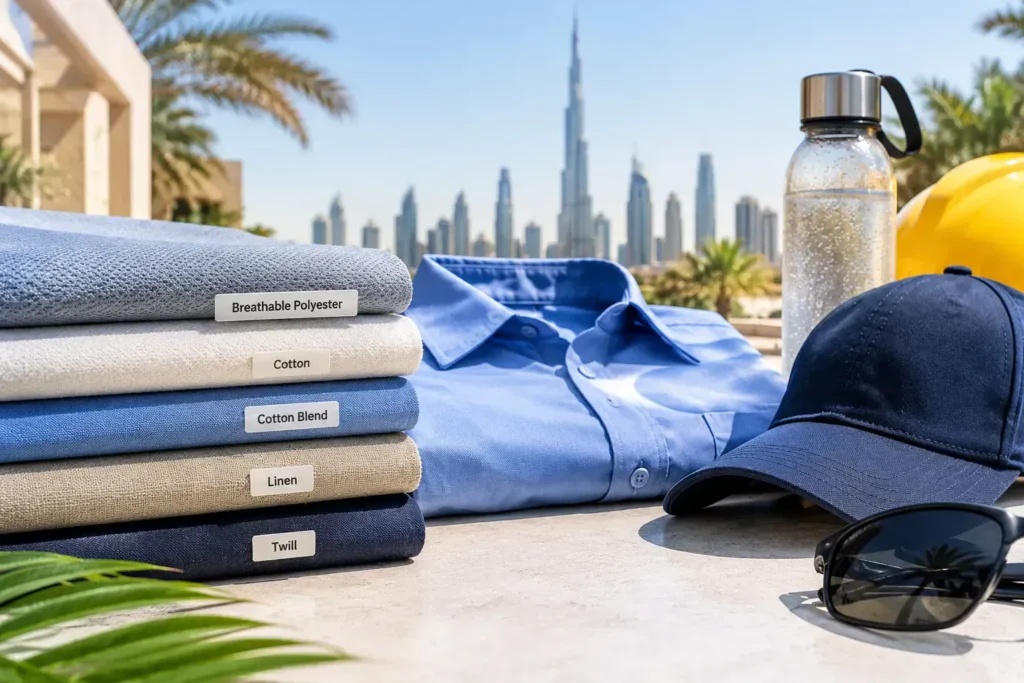
The best uniform fabric for Dubai heat is a light poly-cotton blend or a tested wicking polyester knit, chosen by role. Outdoor crews need 150 to 160 GSM honeycomb pique. Hotel and office shirts need 65/35 poly cotton poplin. Where strength matters, use 80/20 poly cotton twill. Avoid heavy 100% cotton, and avoid cheap polyester that cannot wick. In Dubai, humidity decides comfort, so knit, weave, yarn, GSM, and finish matter as much as fibre.
Below, we cover the NCM climate numbers and what lab studies actually found about cotton and polyester. We then give role-by-role picks, the finishes worth paying for, notes on embroidery for light fabrics, and simple swatch tests you can run at your desk before signing a purchase order.
Why Dubai Heat Is Hard on Uniform Fabric
Heat on its own is manageable. Heat plus humidity is the problem. Sweat only cools the body when it evaporates, and humid air slows evaporation down.
The Summer Numbers That Should Decide Your Fabric
The National Centre of Meteorology (NCM) station at Dubai Airport has records from 1974 to 2023. They show the months your uniform has to survive:
Not sure which fabric will keep your team cool?
Send us your staff roles, headcount and brand colours. We will post free fabric swatches to your Dubai office, send a free mockup within 24 hours and return a line-item quote. Minimum order is 25 pieces per design.
| Month | Mean temperature | Max recorded | Max mean humidity |
|---|---|---|---|
| June | 33.4°C | 47.9°C | 75% |
| July | 35.3°C | 48.5°C | 73% |
| August | 35.5°C | 48.8°C | 72% |
| September | 33.1°C | 46.1°C | 78% |
Read the last column first. Humidity peaks in September at 78%, the month many buyers treat as the easy end of summer. When the air already holds that much moisture, sweat stays on the skin and soaks into the fabric instead of drying off. A shirt that absorbs sweat and holds it stays heavy and hot. A shirt that spreads sweat thinly across its surface gives it the best chance to evaporate.
So the real question is not which fibre is coolest. It is which fabric moves sweat off the skin and dries fastest in humid air.
What the Midday Break Changes for Outdoor Teams
MOHRE’s midday break bans outdoor work under direct sun from 12:30 pm to 3:00 pm. In 2026 it ran from 15 June to 15 September, the 22nd consecutive year of the rule. Gulf News reported in 2025 that fines are Dh5,000 per worker, up to Dh50,000.
The break pushes outdoor work into early mornings and late afternoons, and it creates a split shift. Most workers on an Al Quoz site or a Jebel Ali yard pull the same shirt back on at 3:00 pm. If it is still damp from the morning, the afternoon starts wet. How fast a shirt dries during a two-and-a-half-hour rest is a real specification, not a nice extra.
Cotton vs Polyester vs Poly Cotton: What the Evidence Actually Says
Every buyer has heard the cotton vs polyester uniform Dubai debate. Most suppliers answer it from habit. The research is more interesting.
Why 100% Cotton Struggles in Humid Heat
Cotton absorbs water into the fibre itself. That feels good in a cool office but works against you on a humid site. A cotton shirt soaked by 10 am can still be damp at noon. By then it is heavier, clinging to the skin and holding heat against the body. Cotton is not the villain, though. It feels pleasant when dry, and in lab tests it beat cheap polyester. Its weakness is drying time, and Dubai humidity punishes slow drying.
Why Basic Polyester Can Feel Worse Than Cotton
This is the finding trading companies would prefer you skipped. An evidence brief from the National Collaborating Centre for Environmental Health (NCCEH) reviewed lab studies run at 37°C and 60% relative humidity. Hydrophobic polyester produced more local sweating and felt wetter than cotton. The key detail is that the polyester tested had a wicking rate of 0 mm in 10 minutes. It was not a technical wicking fabric at all. Plenty of “quick-dry” polyester sold in Dubai has no wicking test behind it either.
Polyester built to wick tells a different story. In a study published in Applied Ergonomics, 10 men were tested at 33°C and 60% RH. A polyester/elastane wicking shirt gave a lower rectal temperature than 100% cotton in the final 15 minutes. Ten participants are a small sample, so treat this as a direction rather than proof. The direction is still clear: wicking polyester beat cotton, and non-wicking polyester lost to it. The word “polyester” on a spec sheet tells you almost nothing. The wicking rate tells you a lot.
Where Poly Cotton Blends Win
Blends combine cotton’s soft feel against the skin with polyester’s strength, crease resistance and faster drying. Many staff move between air-conditioned lobbies and a hot taxi rank all day. For them, a blend is usually the most comfortable option across a full shift.
The ratio matters. A 65/35 poly cotton poplin at 120 to 140 GSM makes a light, smart shirt. An 80/20 poly cotton twill at 190 to 210 GSM gives trousers the strength to survive repeated washing. One textile comparison also found that a cotton-Coolmax knit wicked better than plain cotton, viscose and polyester. Blend sensibly and engineer the yarn, and you get comfort and drying speed in one fabric.
Fibre Is Only Half the Answer: Knit, Weave and GSM
Two shirts cut from the same polyester can feel completely different on a Dubai Marina terrace. The difference is construction.
Knit vs Woven for Heat
Textile reviews make a simple split: knitted fabrics suit comfort-first roles, and woven fabrics suit strength-first roles. Knits are made of interlocking loops, so they stretch, move with the body and hold air in their structure. A honeycomb pique adds a raised texture, so less fabric lies flat against wet skin.
Wovens are made of yarns crossed at right angles. They are tighter, stronger and hold a crease, which is why trousers, chef jackets, and formal shirts are woven. If you want breathable uniform fabric in Dubai, start with structure. Use knit on top for anyone moving and sweating. Use woven below the waist and anywhere abrasion or a sharp look matters.
Picking GSM by Job, Not by Habit
GSM means grams per square metre, the weight of the cloth. Uniform fabric GSM is the number most buyers never ask about and most trading companies never volunteer, often because they sell whatever weight they have in stock. Lighter is cooler, up to a point. Too light, and a white shirt turns see-through when wet and the seams wear early. Too heavy, and you are dressing staff in a towel. Choose the weight by job, using the ranges in the role table below.
The dark navy dilemma. Many Dubai brands use navy, black or charcoal. Dark colours absorb more sunlight, so a navy shirt in direct sun runs hotter than the same shirt in white or sky blue. We will not pretend otherwise. If an outdoor team must wear the brand colour, make up for it with construction:
- Drop the weight.
- Use an open pique knit with tested wicking.
- Keep the heavier fabric for trousers.
Another option is to split the palette: navy trousers with a lighter shirt in a brand-approved tint, letting the logo carry the identity. Indoors in a Business Bay office, a dark colour costs staff very little. Outdoors at 3:30 pm in August, it is a real comfort cost.
Best Uniform Fabric by Role in Dubai
This is how we specify uniform fabric for hot weather in the UAE. Every range below is a fabric we already run at our Ajman factory.
| Role | Fabric | GSM range | Why |
|---|---|---|---|
| Outdoor crews, logistics yards (tops) | Honeycomb pique polyester, tested wicking | 150 to 160 | Open knit, dries fast between split shifts |
| Outdoor crews (trousers, workwear) | Poly cotton twill 80/20 | 190 to 210 | Strength without the weight of pure cotton |
| Workshops, heavy abrasion | Cotton twill | 240 to 260 | Durability first; best indoors or in shade |
| Hotel front office, restaurant floor | Poly cotton poplin 65/35 | 120 to 140 | Light, smart, resists creasing |
| Kitchens (chef jackets) | Poly cotton twill 80/20 | 190 to 210 | Woven body for splash protection |
| Offices, reception, schools | Poly cotton poplin 65/35 | 120 to 140 | Cool shirts that hold a press |
| Clinics, pharmacies | Antimicrobial poly viscose spandex | 160 to 180 | Stretch for movement, odour control |
| Security, outdoor posts | Pique top, poly cotton twill trousers | 150 to 160 / 190 to 210 | Treat as an outdoor role |
Site, Logistics and Outdoor Crews
Specify pique polyester tops with a tested wicking rate, poly cotton twill trousers, and the lightest colour your brand allows. Budget two tops per worker for summer so the 3:00 pm restart happens in a dry shirt. That one decision often does more for comfort than any fabric upgrade.
Hotels, Restaurants and Kitchens
Front-of-house staff spend most of their shift in air conditioning, with short bursts outdoors, so 65/35 poly cotton poplin works well. Valets and doormen are outdoor staff and should be specified that way. Kitchens are hot all year, not just in summer. A woven poly cotton twill jacket protects against splashes and holds its shape. If your kitchen runs especially hot, ask about ventilated panels at the back or underarm.
Offices, Clinics, Security and Schools
Office and school shirts suit lightweight poplin. Clinic staff bend, lift, and work long shifts, so antimicrobial poly viscose spandex at 160 to 180 GSM gives them stretch and odour control. Security guards at a Dubai Marina tower gate spend hours outdoors. Specify their uniforms like a site crew’s, not a receptionist’s.
Fabric Finishes Worth Paying For in Heat
A finish is a treatment applied to the fabric. Some finishes earn their cost in heat, and some are marketing.
Moisture wicking. This is the most important finish. Any moisture-wicking uniform fabric for UAE work should come with a wicking test result, not just a hangtag. Ask whether the wicking is engineered into the yarn or applied as a topical finish, because topical finishes can fade with washing. Also ask how many washes the finish is rated for.
Antimicrobial and odour control. Worth it for clinics, hospitality and any split-shift role where a shirt stays damp for hours.
UV protection. Useful for outdoor crews. Ask for a UPF rating on the actual fabric, not a general claim.
Soil release. Worth it on light-coloured kitchen and hospitality wear, where sweat and food stains build up.
Skip any “cooling” claim that arrives without a test method and a number.
Embroidery on Heat-Rated Fabrics
Heat-rated fabrics are light and open. A logo is a dense patch of thread that neither breathes nor stretches. Three things decide whether it stays sharp for months or puckers by the second wash.
Density. High stitch counts on a 120 GSM poplin or 150 GSM pique pull the fabric in and create a stiff, hot patch on the chest. Simplifying the logo or using a lighter fill often fixes both problems.
Puckering on light knits. Pique stretches during stitching and relaxes afterwards, which ripples the fabric around the logo. Correct hooping tension and the right backing prevent most of this.
Backing choice. Knits generally need a cut-away backing for stability, while tear-away backing suits firmer wovens. Soft mesh backings reduce scratchiness against sweaty skin.
Before approving bulk logo embroidery on lightweight fabric, ask for a sample stitched on your actual fabric and colour, then wash it once.
How to Test a Fabric Before You Order 20 or 2,000 Pieces
You do not need a lab. You need swatches, a phone timer, a ruler, and a permanent marker.
- Wet-corner dry-time test. Cut every swatch to the same size and put five drops of water on one corner of each. Watch the first 30 seconds. Water that beads up and sits there is the 0 mm/10 min problem from the NCCEH brief. Water that spreads fast means the fabric wicks. Hang the swatches side by side and time how long each takes to dry.
- Hand-wash shrinkage check. Draw a 10 cm by 10 cm square on each swatch. Hand-wash it in warm water with normal detergent, dry it flat, then measure again. Compare the result against the shrinkage figure the supplier quotes.
- Wet show-through check. Hold the damp swatch against a window. If you can see through it, staff will feel exposed by mid-morning.
Worth asking every supplier: What is the GSM after washing? What is the tested wicking rate? Is the wicking built into the yarn or added as a finish? Can I see my logo stitched on this fabric? A real uniform supplier in Dubai with its own production line can answer in a day. A trading company forwarding your email to a mill often cannot.
Key takeaways
- In Dubai, humidity decides comfort. Choose fabric that wicks and dries fast, not just the “coolest” fibre.
- Untested polyester can feel wetter than cotton. Ask for the wicking rate before you buy.
- Use knit for comfort-first roles and woven for strength-first roles, and choose GSM by job.
- Dark brand colours run hotter outdoors. Make up for it with lighter weight, open knits or a split palette.