What Is MOQ in Uniform Orders and How to Lower It
- Topic
- Uniform Sourcing
- Written
- Read
- 9 min read
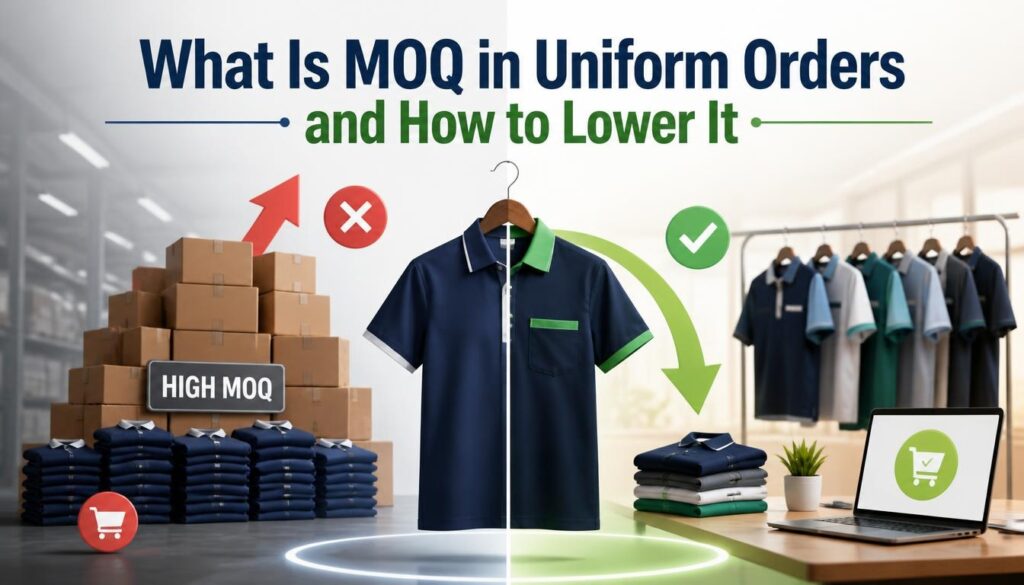
Picture a café owner in Sharjah with nine staff. She asks for three branded polos each, gets a quote back, and spots one line in the small print: “MOQ: 25 pieces per design.” Is that 25 in total? Per size? Per colour? Nobody explains, so the quote sits in her inbox for a week. That single line, the MOQ in uniform orders, trips up more first-time buyers than price does.
This post clears it up. You’ll see what MOQ actually means, why suppliers set one, what’s normal in the UAE, and seven practical ways to bring it down without wrecking your uniform.
Key Takeaways
- MOQ (minimum order quantity) is the smallest run a supplier will produce, and it’s usually counted per design, not per order.
- It exists because fabric rolls, cutting and logo setup cost the same at 10 pieces as at 1,000.
- At UC Uniform, custom uniforms start at 25 pieces per design, and branded ready-made stock starts at 10.
- The easiest ways to lower it: use stock, keep fabrics and colours standard, simplify branding, and deal with a manufacturer directly.
- A lower MOQ usually means a higher price per piece. Order what you’ll actually wear, not the smallest number you can get away with.
What Is MOQ in Uniform Orders?
MOQ stands for minimum order quantity: the smallest number of pieces a uniform supplier will produce for one order. It exists because cutting, fabric rolls and logo setup cost the same whether you order 10 pieces or 1,000. At UC Uniform, custom production starts at 25 pieces per design.
The tricky part is what the “per” refers to. Across apparel in general, factories most often set the minimum per style, and many add a per-colour minimum on top (Sourcify explains how this works). Some suppliers quote an order value instead of a piece count. So “MOQ 25” on one quote and “MOQ 25” on another can mean two very different things. Always ask what the number is counted against.
Not sure your order clears the minimum?
Send us your headcount and roles. We'll tell you the lowest-MOQ route for your team, with a free mockup and line-item quote within one working day.
Why Do Uniform Suppliers Set a Minimum Order Quantity?
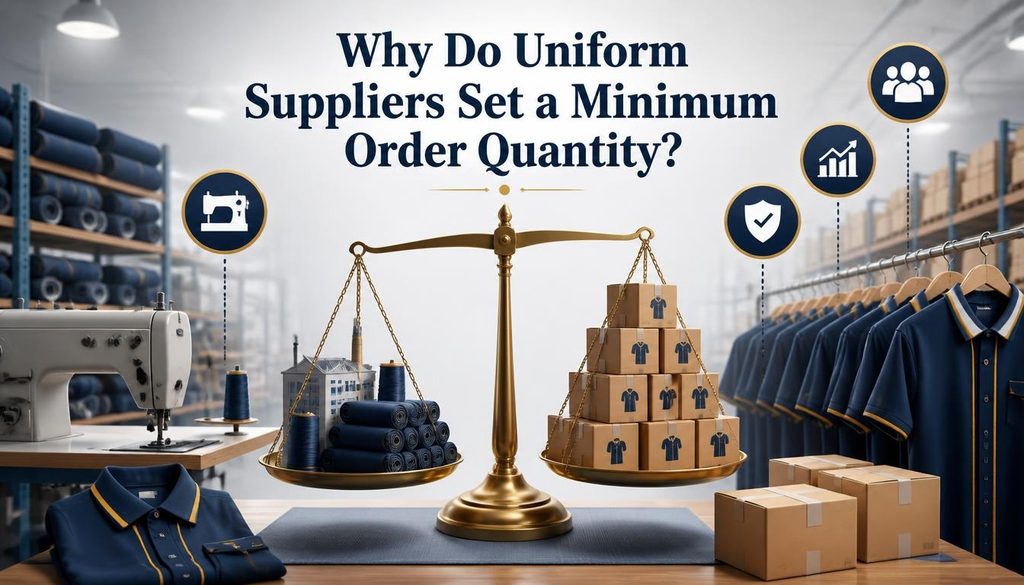
Because the expensive parts of a uniform order are fixed. Fabric arrives by the roll, patterns have to be cut and graded, and every logo needs digitising or screen setup before the first piece is made. A minimum makes sure those costs are spread over enough garments to make the job worth running.
Here’s where the money goes before a single polo is finished:
- Fabric. Mills sell cloth in rolls, and custom colours often come with a dye-lot minimum. That floor sits underneath whatever the garment factory wants to charge.
- Cutting and line setup. Setting up a stitching line for 8 pieces wastes almost as much time as setting it up for 80.
- Logo setup. Embroidery needs a digitised file and thread matching. Screen printing needs a screen per colour.
- The middleman’s own minimum. If your supplier is a trading company, they’re buying from a factory that has its own MOQ. Yours stacks on top.
That last point is the one most buyers miss. A supplier that owns its cutting, stitching and branding floor has fewer layers to protect, so it can usually set a lower minimum. We run all of that under one roof in Ajman, which is why our numbers look the way they do.
What Is a Normal MOQ for Uniforms in the UAE?
There’s no single standard. Across apparel generally, minimums of roughly 50 to 500 pieces per style are common (WearView’s apparel glossary), while UAE manufacturers that own their production line can go lower. UC Uniform’s custom minimum is 25 pieces per design, and ready-made stock with branding starts at 10.
| Ordering route | Typical MOQ | Typical lead time | Best for |
| Ready-made stock with logo | From 10 pieces (UC Uniform) | 3 to 5 working days | Small teams, tight deadlines |
| Custom-stitched by a manufacturer | From 25 pieces per design (UC Uniform) | 10 to 15 working days, 5 on rush | Specific fabric, fit or colour |
| Trading company, custom order | Often 50 to 100 pieces, based on UC Uniform’s own market comparison | Depends on their factory’s queue | One-off catalogue buys |
Treat the trading company row as a rough guide, not a rule. Some traders are flexible and some factories aren’t. The point is to compare like with like when quotes arrive.
Is MOQ Counted Per Design, Per Size or Per Order?
It depends on the supplier, so ask before you compare quotes. Most apparel factories count it per style, and some add a per-colour minimum. At UC Uniform, the minimum is 25 pieces per design, and you can put several designs on one purchase order. Your size split goes in the brief.
Here’s why it matters. A hotel ordering 25 housekeeping sets and 25 front-desk sets on one purchase order has met the minimum twice, with no penalty for splitting. But the same hotel ordering 10 each of five designs hasn’t met it once. Five small designs cost far more than two larger ones, and that’s the mistake we see most often.
How Can You Lower the MOQ on a Uniform Order?
Start with ready-made stock, stick to standard fabrics and colours, and keep branding simple. Then bundle departments or branches into one purchase order and share your annual volume up front. Finally, deal with the manufacturer directly, because every middleman adds a minimum of their own.
Here are the seven levers, roughly in order of how much they help:
- Order ready-made stock with your logo. This is the lowest entry point we offer: branded polos, formal shirts, scrubs, trousers, caps and hi-vis from 10 pieces, shipped in 3 to 5 working days. If you don’t need a custom cut, this is the answer.
- Stay on standard fabrics and colours. Custom-dyed cloth is what pushes minimums up. A navy or white poly-cotton from the regular range avoids the problem entirely. Our uniform stitching service can work from fabrics we already cut.
- Reuse one fabric across designs. A shirt, trouser and apron cut from the same cloth share one fabric run, so each design needs less cloth to clear the line.
- Keep branding simple. One logo, one placement and fewer thread colours means less setup. Our logo embroidery runs Pantone-matched thread, but every extra colour is an extra setup.
- Bundle everything into one purchase order. If three branches or two departments each need a handful of pieces, combine them. Sort by size and department at packing, not at ordering.
- Share your annual volume at quote stage. If you’re planning a phased rollout, say so. We price against the total commitment, not just the first delivery.
- Deal with the manufacturer, not a reseller. No middleman means no stacked minimum. You also get a straight answer from the people who run the machines.
What Does a Lower MOQ Cost You?
Honestly, usually a higher price per piece. Smaller runs spread the same setup cost over fewer garments, so each one carries more of it. You may also get fewer fabric and colour choices, and ready-made stock limits you to what’s on the shelf.
My view: chasing the lowest possible MOQ is rarely the smart move. A uniform order that leaves you with five spare XXL polos and a short run of mediums costs more in the end than a slightly bigger, well-planned one. Add a small buffer for new hires and replacements, then reorder from the same fabric lot and thread codes so batch two matches batch one.
How Do You Work Out the Right Quantity? Two Quick Examples
These are illustrations, not client stories. Swap in your own headcount.
A café with 9 staff. Three polos each is 27 pieces. That clears the 25-piece custom minimum on a single design, so a custom-cut polo is on the table. If you also want aprons, our restaurant uniform range covers both.
A salon with 8 staff. Two tunics each are 16 pieces, which falls short of a custom run. You have two honest options: go with ready-made stock from 10 pieces, or add a spare set for future hires and reach 25 on a custom design. Our salon and spa uniform page shows what’s available either way.
When Is a Trading Company or Reseller the Better Choice?
Sometimes they are. If you need fifteen polo shirts by Thursday, a reseller with stock on the shelf will beat any factory on speed. The same goes for one-off events where you’ll never reorder. A factory earns its place on repeat volume: consistent colour across reorders, a written specification, and pricing without a margin layer you can’t see.
What Should You Ask a Supplier About MOQ Before You Agree?

Six questions will save you most of the back-and-forth:
- Is the MOQ per design, per colour, per size or per order?
- Does it change between custom-cut and ready-made stock?
- Can I put several designs on one purchase order?
- Is the logo setup included, or billed per colour?
- What happens to my fabric lot and thread codes when I reorder?
- Will you quote on my annual volume, not only the first batch?
If a supplier can’t answer these in plain words, that tells you something.
FAQs About MOQ in Uniform Orders
What does MOQ stand for in uniforms?
MOQ stands for minimum order quantity. It’s the smallest number of pieces a supplier will produce for one order or one design. It covers fixed costs like fabric rolls, cutting and logo setup that don’t shrink when the order does.
Can I order fewer than the MOQ?
Sometimes. The usual route is ready-made stock, which is already cut and just needs your logo. At UC Uniform, branded stock starts at 10 pieces, against 25 for a fully custom design.
Is MOQ per design or for the whole order?
Most factories count it per design. At UC Uniform it’s 25 pieces per design, and there’s no limit on how many designs sit in one order. Always confirm what the number is counted against before comparing quotes.
Does ordering more lower the price per piece?
Usually, yes. Setup costs get spread over more garments, so each carries less. If you’re planning a phased rollout, tell your supplier the full annual quantity so they can price against it.
Can MOQ be negotiated?
Often, within limits. The most effective negotiation isn’t pushing the number down; it’s changing the order: use stock fabric, cut the design count, or bundle branches. Those reduce the supplier’s real costs, so they can say yes.
The Short Version
MOQ isn’t a penalty. It’s the factory’s way of covering costs that don’t scale down. Know what the number counts, simplify the order around it, and pick the route that fits your headcount. If your numbers sit just under a minimum, that’s a conversation worth having rather than a reason to walk away.
Not sure whether your team clears the line? Send us your headcount and roles and we’ll tell you the lowest-MOQ route that works. You can also browse our corporate uniform and hotel uniform ranges first.