MOHRE Midday Break: What Your Workwear Has to Handle
- Topic
- Uniform Sourcing
- Written
- Read
- 7 min read
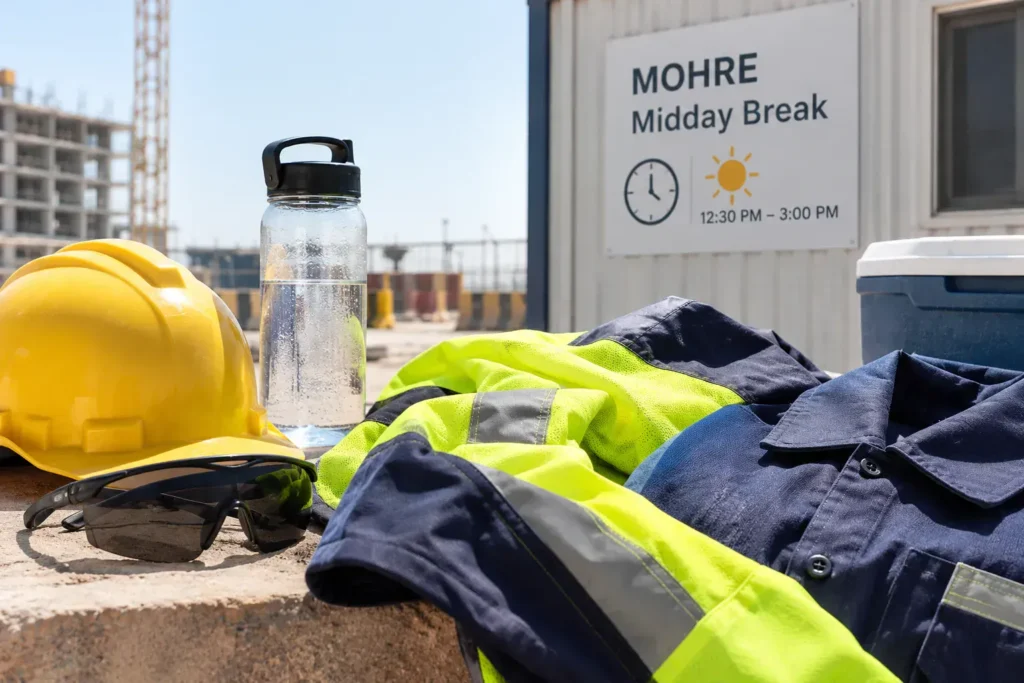
Every employer in the UAE knows the MOHRE midday break. Two and a half hours, three months, posted on every site notice board.
Almost nobody plans for the other five and a half hours of the shift, and that is where people actually get hurt.
Here is the part that gets missed. The crew goes back to work at three o’clock. In August, three o’clock is usually hotter than noon.
The MOHRE midday break rule, in one paragraph
Outdoor work in direct sunlight is banned from 12:30pm to 3:00pm, every day from 15 June to 15 September. 2026 was the twenty second consecutive year. The fine is AED 5,000 per violating worker and up to AED 50,000 for repeated breaches, and the Ministry can suspend a company’s labour file or downgrade its classification on top of that.
Workwear that has to survive a UAE summer?
Tell us the site, the shift pattern, and whether hi-vis is worn over the garment or built into it. We will spec the weight, weave and colour for those conditions, and tell you plainly where a lighter cloth is not an option.
A few categories are exempt where work cannot stop for technical reasons, mainly asphalt laying, concrete pouring, emergency utility repairs and approved works affecting traffic or critical infrastructure. Exempt employers still have to meet the welfare requirements.
Those requirements are shaded rest areas, cooling equipment at the site, enough drinking water and approved rehydration salts, and first aid kits on location.
Read that list again and notice what is not on it. Nothing about what the crew is wearing.
The banned hours are not the dangerous hours
Solar noon in the UAE falls around 12:20. Air temperature does not peak with the sun, because the ground, the concrete and the steel keep absorbing heat and releasing it for hours afterwards. The daily maximum usually lands somewhere between two and four in the afternoon.
So the rule takes the crew off site at 12:30 and puts them back at 3:01, which is close to the hottest part of the day. That is not a flaw in the rule. The break is there so the body can recover before the peak, not so the peak can be avoided.
Which means the clothing is what your crew faces the peak in.
Above 35 degrees, clothing is the only cooling you have
The body sheds heat four ways: conduction, convection, radiation and evaporation. Three of those depend on the surroundings being cooler than you are.
Skin sits at roughly 33 to 35 degrees. Once the air goes above that, which in a UAE July is most of the working day, those three routes do not just stop. They reverse. The air, the ground and the sun start adding heat to the body instead of taking it away.
That leaves evaporation. Sweat turning to vapour is the only cooling mechanism still working, and it only works if the vapour can get off the skin and out through the cloth.
This is the whole argument. In those conditions, a fabric that blocks evaporation is not uncomfortable. It is the thing standing between a worker and heat exhaustion.
Why the coast is harder than the desert
Evaporation needs somewhere for the vapour to go. The drier the air, the faster sweat evaporates and the more heat leaves with it.
Inland UAE runs hot and dry. The coastal strip through Dubai, Sharjah and Abu Dhabi runs slightly cooler on the thermometer and far more humid. Forty two degrees at seventy percent humidity on a coastal site puts more strain on the body than forty eight degrees at fifteen percent inland, because on the coast the sweat has nowhere to go. It runs off instead of evaporating, and sweat that drips cools nothing at all.
If your sites span both, the same coverall is not the right answer in both places.
Five fabric properties that actually decide it
Air permeability. How much air passes through the cloth. A tightly woven heavy twill blocks it almost completely. An open weave ripstop at a lower weight lets air move. This is the single most useful number to ask for and the one almost no supplier volunteers.
Moisture vapour transmission. How much water vapour passes through per square metre. Directly related to whether sweat can evaporate or just sits there.
Weight. Lower gsm generally runs cooler, but durability and flame resistance both pull the other way. This is a genuine trade off, not a free win, and anyone telling you otherwise is selling something that will not last the season.
Colour. A dark navy coverall in direct sun absorbs noticeably more radiant heat than a light grey, sand or khaki one. The site may have a colour convention. It is worth checking whether that convention was chosen for a reason or just inherited.
Fit. Loose clothing lets air move between the cloth and the skin, which carries vapour away. Tight clothing kills that movement. Traditional Gulf dress is loose and pale for reasons that predate every fabric lab, and the reasoning still holds.
The layer nobody counts
Here is the one that catches people out.
Heat stress is commonly assessed with WBGT, and WBGT adds a clothing adjustment to the measured reading. A second woven layer adds roughly three degrees to the effective number. A vapour barrier suit adds around ten.
So a hi-vis vest pulled over a coverall is not neutral. It is a second layer, and on paper it pushes the site a few degrees up the heat stress scale. The safety gear is adding to the risk it was issued to reduce.
The fix is not to drop the hi-vis. It is to stop making it a separate layer. Retroreflective tape applied to the coverall itself, certified as one garment, gives the same visibility without the extra layer of trapped air. Any serious industrial coverall specification for a UAE summer should be built this way rather than relying on a vest over the top.
Why this is a schedule problem, not a comfort problem
Thermal Work Limit is used widely across Gulf industry, including by the large energy operators, to set a sustainable work rate for the conditions on the day.
The important detail for a procurement team is this. TWL takes clothing as an input. Same site, same weather, different coverall, different limit. Change the fabric and you change how hard the crew is allowed to work and for how long.
That moves workwear off the stationery line of the budget. A coverall that breathes properly buys productive hours in July. One that does not costs them, and the cost appears as slower progress and incident reports rather than as an invoice anybody looks at.
It is also not only a construction question. Valet staff, pool attendants, landscapers, drivers and outdoor F&B crews are all covered by the same rule, and hotel uniform programmes rarely spec outdoor roles any differently from indoor ones. In a UAE August, they are not the same job.
What to put on the purchase order
Six lines. Any supplier running their own floor can answer all six.
Fabric weight in gsm, with a range rather than a single figure. Weave type, and the air permeability figure that goes with it. Colour, chosen deliberately. Whether hi-vis is integrated into the garment or worn over it. Fit allowance through the chest and back, because a size down is not a cost saving in summer. And if the work is flame resistant, which standard applies, because that constrains everything above it.
Ask what the fabric does at forty five degrees. Not whether it is comfortable. What it does. If the answer is a brochure adjective rather than a number, you have learned something useful about the supplier. A construction uniform supplier who runs their own cutting and stitching floor will have the technical data sheet for the cloth and can send it the same day.
One honest point to close on
The MOHRE midday break says nothing about fabric. Nobody is going to fine you AED 5,000 for a badly chosen coverall.
That is exactly why it gets ignored. The break is enforced, so it gets planned for. The clothing is not, so it gets bought on price, and the cost comes back as heat incidents in July and a crew working at two thirds pace through August.
Shade, water and salts are the legal minimum and you are already providing them. What the crew wears in the five and a half hours around the break is the part still left on the table.