
Embroidery vs Printing on Uniforms: Which Lasts Longer
- Topic
- Uniform Sourcing
- Written
- Read
- 8 min read
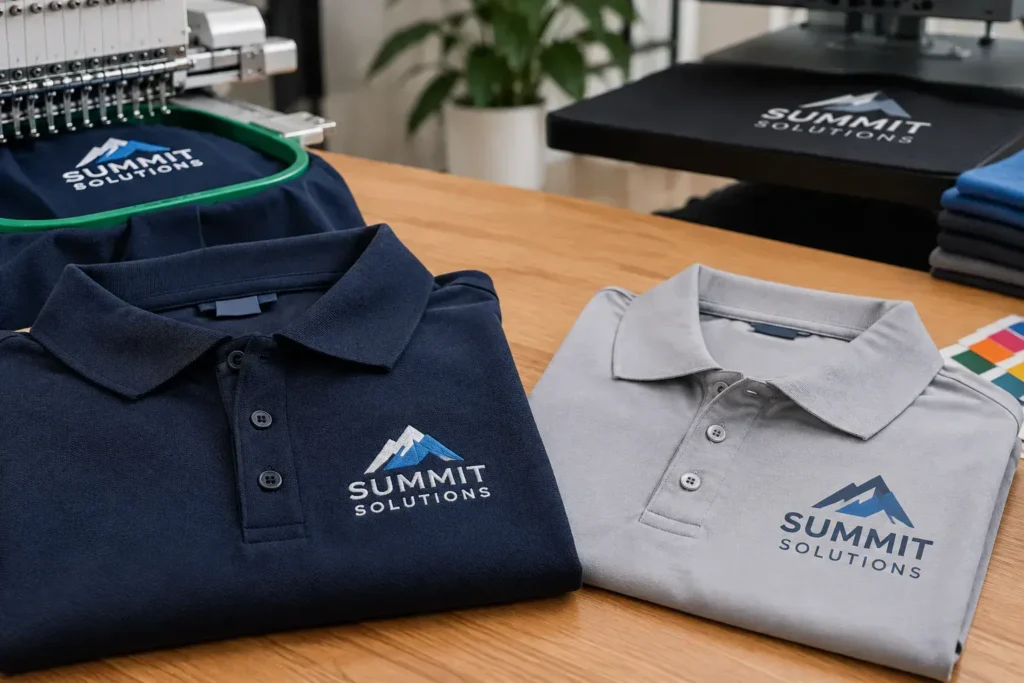
A hotel in Dubai replaced four hundred polo shirts last year. The shirts were fine. The printed chest logos had cracked along the fold line and the general manager would not let staff wear them past reception.
That is what getting embroidery vs printing wrong actually costs. The garment outlives the logo, so you buy the whole set again and the fabric budget was never the problem.
Most suppliers answer this question with a preference. The honest answer depends on three things, and none of them is taste.
Embroidery vs printing: the short answer
Embroidery lasts longer than every printing method except one.
Not sure what your logo can take?
Send the logo file and tell us who washes the uniform and at what temperature. We will tell you whether it embroiders cleanly, needs redrawing, or should be printed instead, and what each costs at your quantity.
Thread is stitched through the cloth, so there is no layer sitting on the surface waiting to fail. It cannot crack because there is nothing rigid to crack, and it cannot peel because there is nothing stuck on. On a commercial laundry contract, embroidery normally outlives the fabric it is sewn into.
The exception is sublimation on polyester, where the dye turns to gas and bonds inside the fibre. The mark becomes the fabric. You cannot feel it with a hand and there is physically nothing there to lift.
Everything else, plastisol screen print, heat transfer vinyl, DTG, DTF, sits on or just under the surface and fails in a fairly predictable order.
Why embroidery survives a commercial laundry
This is the part that decides most B2B orders, and it comes down to temperature.
An industrial laundry working to ISO 15797 runs the wash at 75 to 85 degrees in a strongly alkaline bath, pH 10 to 12, then puts the garment through a tunnel finisher at 150 to 180 degrees. That is not a hot wash. That is a chemical and thermal cycle designed to strip oil out of workwear.
Plastisol screen printing ink cures at around 160 degrees. Send it back through a finisher at 180 and the ink film softens again, every single cycle. Heat transfer vinyl is bonded with a press at roughly 150 to 160 degrees, so the finisher is sitting right on its adhesive activation point. Polyester embroidery thread melts at around 250. It never comes close.
Run the same garments through a domestic machine at 40 degrees, which is what ISO 6330 describes, and the whole argument changes. Prints last far longer when nobody is cooking them twice a week.
Where embroidery does fail
It is worth being straight about this, because embroidery has its own failure modes and they are mechanical rather than chemical.
Snagging. Thread sits proud of the fabric. Velcro, trolley edges, pallet racking and ID lanyards all catch it. One good pull leaves a loop hanging out of your logo and it cannot be repaired invisibly.
Puckering on light fabric. A dense fill on single jersey under about 160 gsm distorts the cloth around it. The logo is fine. The shirt looks dented.
Needle holes in stretch. On fabric with elastane, hundreds of needle penetrations through the same small area break the recovery. The area goes slack while the rest of the garment holds.
Weight. Anything much over 150mm wide on a back panel gets stiff and hot. That is a comfort problem in a UAE summer, not just a cost one.
Printing is four different products, not one
Lumping them together is why this comparison usually goes nowhere. The gap between the best and worst print method is larger than the gap between printing and embroidery.
Screen printing
Standard plastisol lays an ink film on top of the fabric. Cheap per piece at volume, and the only method where a big bold mark costs almost nothing extra. Visible cracking usually starts somewhere between thirty and forty domestic washes, and it starts on the fold line across the chest because that is where the film flexes most. Water based and discharge inks go into the cotton instead of onto it and last noticeably longer, but they only work properly on cotton and mostly on light grounds.
Heat transfer vinyl
Cut vinyl pressed onto the garment. This is the right answer for names and squad numbers, because every piece is different and there is no setup cost per design. It fails at the corners first, lifting after roughly twenty to fifty washes, and much sooner than that on an industrial cycle.
DTG and DTF
DTG inkjets pigment into cotton fibres. It handles photographic artwork and small type beautifully, fades visibly by around wash twenty to thirty, and does not work on polyester. DTF prints onto a film that bonds to almost any fabric including polyester, which solves the fabric problem and lands around forty to sixty washes. It is still a layer on the surface, so it is still a layer that can eventually lift.
Sublimation
Polyester only, and it needs a white or light base to work on. In exchange the mark cannot crack, cannot peel, does not fade and adds no weight or stiffness at all. For polyester hospitality and sports shirts it is the longest lasting decoration available, full stop, and it is the only method that genuinely beats thread on wash life.
Wash life by method
| Method | Where it fails first | Typical wash life | Survives 85°C laundry |
|---|---|---|---|
| Embroidery, polyester thread | Snagging, not washing | Outlasts the garment | Yes |
| Sublimation on polyester | Nothing to fail | Life of the garment | Yes |
| DTF | Edges, then surface gloss | 40 to 60 | No |
| Screen print, plastisol | Cracks on the chest fold | 30 to 40 | No |
| Heat transfer vinyl | Corners lift | 20 to 50 | No |
| DTG | Fades evenly | 20 to 30 | No |
Those ranges move with fabric, ink quality and how the garment is dried. Tumble drying on high costs every print method a third of its life.
Who washes the uniform decides the answer
Work out this one thing before you look at a single sample.
Contracted laundry with a tunnel washer. Embroidery or sublimation. Nothing else is worth quoting, and a supplier who offers you a screen printed polo for a laundry contract has not asked the right question.
In-house laundry at 60 degrees. Embroidery, sublimation, or good DTF. Plastisol will get you two seasons.
Staff wash at home. Almost anything works. Judge on how it looks and what it costs, because wash life has stopped being the deciding factor.
When printing is the only option
Thread has a minimum feature size, and plenty of logos sit below it.
Text under about 4mm cap height will not read in stitch. Gradients cannot be done at all, only approximated in layered colour, which looks like a different logo. A large back mark at twenty thousand stitches is slow, heavy and expensive when the same thing printed costs very little. And on fabric with meaningful stretch, needle holes are the problem rather than the solution. In all four cases workwear printing services are the correct answer and not the cheap one.
When embroidery is the only option
Two of these are safety, not preference.
On flame resistant garments, polyester thread and plastic print film both melt and both stick to skin. EN ISO 11612 and NFPA 2112 garments need aramid thread, Nomex or Kevlar, with no plastic film anywhere on them. Any supplier branding an industrial coverall with standard polyester thread has just taken the certification off it.
On hi-vis, nothing goes through the retroreflective tape. Needle holes destroy the retroreflectivity and heat flattens the glass beads. EN ISO 20471 also counts visible surface area, so a large mark covering tape can drop the garment a whole class. Logos go on the base fabric, between the bands, and they go there in thread.
Beyond safety, there is the simple matter of how close people stand. Front of house staff are read at conversation distance, where a cracked print is visible and thread still looks deliberate. That is the honest case for uniform embroidery services on client facing roles even when the laundry would forgive a print.
Cost moves in opposite directions
Embroidery is one digitising fee for the design, then a per piece cost set by stitch count. Quantity barely moves it. Screen printing is one screen per colour per design, so a four colour logo is four setups, and after that the per piece cost is very low. At twenty five pieces the setup dominates the invoice. At five hundred it has disappeared.
So embroidery usually wins under about fifty pieces, printing wins in the hundreds, and in the middle it comes down to how many colours your logo has.
What to send before deciding
Five things, and a supplier who runs their own machines can answer the same day.
Vector artwork in AI, EPS or PDF rather than a JPG. The smallest size you want the mark at, in millimetres. Who washes the garment and at what temperature. The fabric and its gsm. Quantity, and how often you reorder.
Then ask one question that cuts through the whole embroidery vs printing debate. Ask what happens to this decoration at wash fifty on your actual laundry cycle. If the answer is vague, the answer is that nobody has checked.