Uniform Fabric GSM Guide for UAE Climate
- Topic
- Uniform Sourcing
- Written
- Read
- 8 min read
- Updated
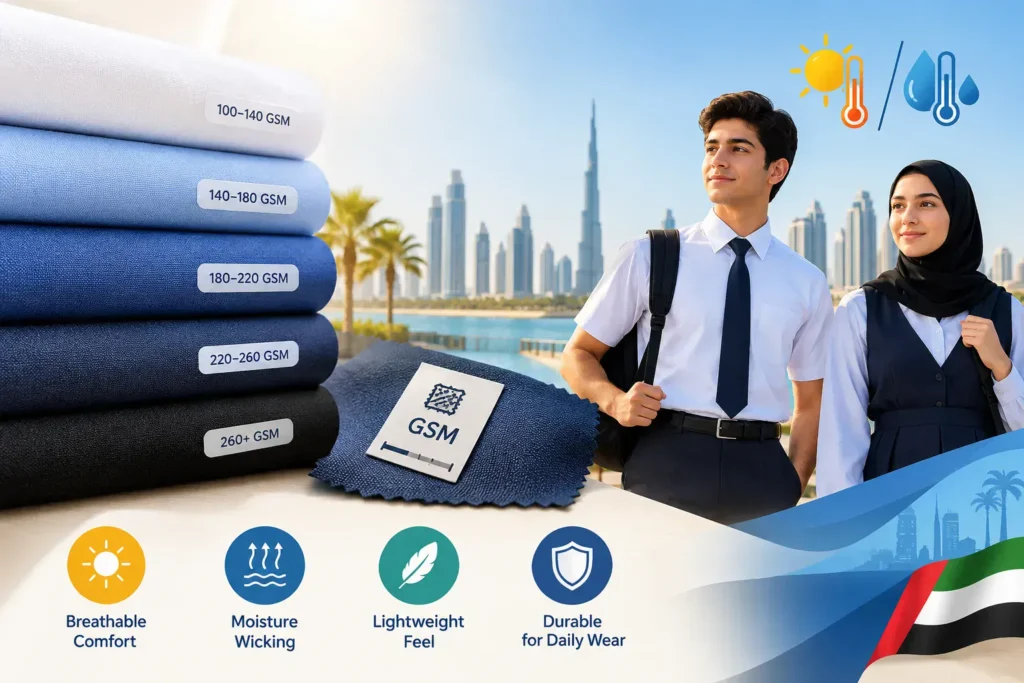
Ask three suppliers about uniform fabric GSM and you will get three numbers and no explanation. Two hundred, one eighty, two forty. Buyers compare those figures across quotes and pick whichever sounds right for a hot country, which usually means the lowest.
What GSM actually measures
GSM is grams per square metre. It is the weight of the cloth, nothing else. It does not measure breathability, it does not measure how cool something feels, and it does not measure quality.
You can take two fabrics at the same 200 GSM and have completely different garments. A tight poplin weave at 200 GSM traps air and sits warm. An open twill at the same weight moves air and sits cool. Same number on the quote, opposite experience for the person wearing it.
So GSM is useful, but only as one line in a spec. On its own it tells you how heavy the cloth is and how long it will last, and that is about it.
Not sure which weight your floor needs?
Tell us who works indoors, who works outside, and who washes the uniforms. We will put a fabric and a weight against each role, with a price.
What actually decides how a uniform feels
- Fibre blend. How much polyester, how much cotton, and whether the polyester has a wicking finish.
- Weave or knit construction. Poplin, twill, oxford, pique. This is the air movement.
- Finish. Moisture management, soil release, anti-wrinkle. These change the surface, not the weight.
- GSM. The weight, which mostly decides durability and how the garment hangs.
Most suppliers quote you the fourth one and stay quiet about the first three.
The UAE is a humidity problem, not a heat problem
Here is the part that changes everything.
Sweat cools you by evaporating. That is the whole mechanism. When the air is dry, even at 45 degrees, sweat lifts off the skin and takes heat with it, and a light cotton shirt feels wonderful.
Now take a coastal August in Ajman, Sharjah or Dubai Marina. Humidity sits at 80 to 90 percent through the night and most of the morning. The air is already close to full of water. Sweat has nowhere to evaporate to, so it stays on the skin, soaks into the cloth, and the garment goes heavy and sticks.
At that point “breathable” stops meaning much. What matters is whether the fabric moves moisture off the skin and dries fast, or holds it.
Which is why the cotton advice backfires
The standard line is go cotton for hot climates. In dry inland heat, fine. On the coast in summer, cotton is the worst thing you can put on somebody who sweats.
Cotton absorbs moisture and keeps it. A cotton shirt at 180 GSM can hold a significant share of its own weight in water, and in high humidity it has no way to give it back. It stays wet, it gets heavy, it clings, and it shows patches.
Polyester does not absorb. With a wicking finish it pulls moisture to the outer surface and spreads it out, where even slow evaporation can work on it. That is why a 65/35 polyester-cotton at 200 GSM will usually feel drier in August than a 100 percent cotton at 160.
Cotton still wins on initial feel, on breathability in dry air, and on how it takes a crease. Which is why most uniform programs here sit on a blend rather than either extreme.
GSM by role, and why outdoor goes up
This is the table most people are looking for. Read it together with everything above, not instead of it.
| Where they work | Typical GSM | Usual blend | Why |
|---|---|---|---|
| Office, air conditioned | 150 to 180 | 60/40 or 65/35 PC | Barely sweats, wants drape and a crisp look |
| Hotel front of house | 190 to 220 | 65/35 PC | In and out of the heat, must not show patches |
| Kitchen and laundry | 190 to 210 | Polyester rich | Constant heat, washed hard, dries fast |
| Housekeeping | 170 to 200 | 65/35 PC with stretch | Moves all shift, needs to survive the wash |
| Site and outdoor | 220 to 260 | Cotton rich or FR | Sun, abrasion, and in FR the standard sets the floor |
| Flame resistant coverall | 240 to 320 | Inherent or treated FR | The standard dictates it, not comfort |
Notice the direction of travel. Outdoor work goes up in weight, not down, which is the opposite of what the “hot country means light fabric” logic would tell you.
Three reasons outdoor weight increases
First, sun. UV protection comes from how tightly the cloth is woven and how dark it is, and both tend to come with weight. A thin pale shirt lets ultraviolet straight through to skin that is already under a 45 degree sun.
Second, abrasion. Scaffolding, concrete, steel edges, a harness rubbing the same spot for nine hours. Light cloth wears through at the shoulder and the seat long before the rest of the garment is finished.
Third, the standards. If the job needs flame resistance or high visibility, the standard sets a minimum and comfort does not get a vote. That is a different conversation, and it belongs with a construction uniform supplier who can show you what the certificate actually covers.
Worth knowing alongside this: the UAE midday break rule bans outdoor work between 12.30 and 3pm from the middle of June to the middle of September. It takes the worst three hours out of the day, which changes the fabric brief more than any GSM number does.
The number on your quote is not the number you get
Two things happen to GSM between the quote and the uniform room, and neither is usually explained.
Mill tolerance
Fabric is made to a target, not an exact figure. Most mills work to a tolerance of around five percent either side. Order 200 GSM and 190 is a legitimate delivery. Nobody is cheating you, it is simply how weaving works.
It matters when you are ordering against a standard with a minimum weight, or when you are comparing two quotes where one supplier quoted 200 and the other 190. Those two may well be the same cloth.
The fix takes one line in the purchase order: state the GSM and state the tolerance you will accept. If you need a floor rather than a target, say so.
What the wash does
Fabric is tested for industrial laundry under ISO 15797, which puts it through the kind of heat, chemistry and mechanical action a commercial laundry uses. Garments come out of that process changed. They shrink a little, the surface abrades, and the measured weight drifts.
So a fabric quoted at 200 GSM is 200 GSM new. After fifty industrial cycles it is something else. If a garment is already at the bottom of its weight band when it arrives, it will be under it well before the uniform is due for replacement.
Ask any supplier what the fabric was tested to and how many cycles. If the answer is vague, the number on the quote is a sales figure rather than a specification.
Colour does more than you think
Two garments, same fabric, same GSM, different colours, and they do not behave the same.
Dark colours absorb heat and show salt marks from dried sweat. Pale colours stay cooler in sun but show every stain and need a shorter replacement cycle. Mid tones such as grey, stone and navy are where most programs settle, and that is not a design preference, it is a laundry decision.
There is a second effect buyers rarely budget for. Darker shades need more dye, hold it unevenly across batches, and fade visibly. Order a top-up six months later and it will not match the first run. If a uniform must look consistent across a floor, lock the colour reference at the start and keep it on file. A corporate uniform supplier should be holding that reference for you rather than matching by eye each time.
Three questions before you approve a fabric
- How much of the shift is spent outside? Not what the job title says. A concierge is indoor on paper and outdoors twenty times a day.
- Who washes it, and how? Industrial laundry and home washing are different worlds, and the fabric that survives one can be ruined by the other.
- What is the replacement cycle you are budgeting for? Lighter fabric costs less per piece and is replaced sooner. The cheaper quote is often the more expensive program.
Answer those three and the GSM mostly chooses itself.
The mistake that costs the most
Specifying for the hottest day of the year.
August in Ajman is brutal, and it is also about six weeks long. The rest of the year is pleasant, and from December to February mornings on site are genuinely cold. A uniform chosen purely to survive August is thin and cheap-feeling for the other ten months, and staff start wearing their own layers over it, which is the end of a uniform program.
Spec for the ordinary day. Deal with the extreme weeks through layers and short sleeve options, not by making the whole program lighter.