Uniform Manufacturer vs Trading Company in the UAE: What Changes for Buyers
- Topic
- Uniform Sourcing
- Written
- Read
- 9 min read
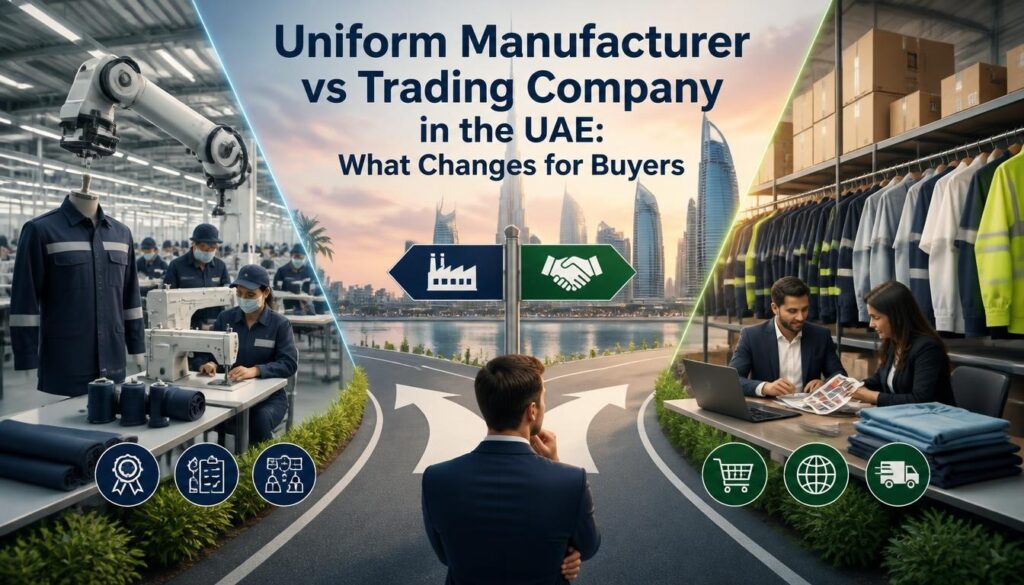
Say you’ve got two quotes for 300 polo shirts. Same logo, same navy, same fabric weight on paper. One is cheaper by a fair margin. The other comes with a promise: pre-production sample by Friday. Most people pick on price and hope for the best. Fair enough, but there’s a question worth answering first.
Who is actually making those shirts? That’s really the uniform manufacturer vs trading company question, and it quietly decides how your order goes: what you pay, how fast a sample shows up, what happens when you change your mind in week two, and who you phone when a seam splits. Full disclosure, we’re a manufacturer, so factor in our bias. We’ll be straight about where a trader is the better call.
Key takeaways
- A uniform manufacturer cuts, stitches and embroiders garments in its own factory under an industrial licence. A trading company buys finished garments from factories and resells them under a commercial licence.
- Buying direct from a uniform manufacturer often removes one margin and one relay when the spec changes, but only if the order is really sewn in-house.
- A trading company is usually the better choice for small, mixed or urgent uniform orders.
- To tell the two apart, ask who cuts the fabric, who sews the garment, and who handles problems after delivery.
- Some trading companies own factories, and some manufacturers subcontract when they’re busy, so verify instead of trusting the label.
What is the difference between a uniform manufacturer and a trading company?
A uniform manufacturer owns the production line. It cuts, stitches, embroiders and finishes your garments itself, under an industrial licence. A trading company buys finished uniforms from one or more factories and resells them under a commercial licence. The shirt in your hand can look identical either way. What changes is who’s in control of everything behind it.
In the UAE, the split shows up in the paperwork. Making things needs an industrial licence, and factories also go through MoIAT, the federal industry ministry, which keeps an industrial register of approved factories. Buying and selling finished goods sits under a commercial licence. Neither is better or worse. They just tell you what a company is set up to do and, usually, what it actually controls.
Not sure who is actually making your uniforms?
Send us the quote you already have, plus your item list and headcount. We'll tell you what we can make in our own factory and where a trading company may suit you better, with a quote back within one working day.
What actually changes for buyers?
A uniform manufacturer and a trading company can supply the same garment, but the chain behind it is different. Here’s where buyers actually feel that difference: price, spec changes, customisation, lead time, minimum order, range and after-sales support.
| What you’re comparing | Uniform manufacturer | Trading company |
| Price | One margin, the factory’s. Fabric, labour and decoration are visible in the quote. | Factory margin plus the trader’s margin. Can still win on small or mixed orders. |
| Changing the spec after the sample | Handled directly with the pattern, cutting and stitching teams. | Passed from the trader to the factory and back, which adds time. |
| Embroidery and printing | Usually done in-house, so crest files and colour codes sit with one team. | Depends on the factory used, and is often sent to a third party. |
| Lead time | Set by the manufacturer’s own production schedule. | Set by the factory’s schedule plus the trader’s handling time. |
| Minimum order | Usually higher, because every production run has set-up work. | Usually lower, because stock or small lots can be sold. |
| Range | Narrower: the garments the factory makes well. | Wider: many items sourced from many places. |
| When something goes wrong | The buyer deals directly with the people who made the garment. | The buyer deals with the trader, who then deals with the factory. |
Who controls the price?
A manufacturer builds its price from fabric, labour, decoration and its own margin. A trader’s price has all of that inside it, because the trader pays a factory first, then adds margin and handling on top. Traders aren’t expensive by default. A manufacturer just has one more place to find savings when the order is big and keeps repeating.
In UC Uniform’s school uniform cost breakdown, a shirt on a bulk school order cost AED 35 to 75 at factory level, against around AED 90 at school shops in the UAE. The two aren’t like-for-like, since a school orders hundreds and a parent buys one. Still, the gap shows how much of a final price is supply chain rather than fabric.
Who can change the spec after you’ve approved the sample?
With a manufacturer, whoever hears about the change is usually a few metres from the people who’ll act on it: patternmaker, cutter, machinist, embroidery operator. With a trader, your request goes to the trader, then to a factory, then back to you. Doable, just slower, and details drop out along the way.
Uniform orders change often after the sample is approved. A crest looks a touch high, a hotel swaps its button colour, a school adds a house colour for sports day. When pattern-making, uniform stitching services and crest embroidery sit under one roof, that change is a quick conversation. When they don’t, it becomes an email chain.
Who do you call when something goes wrong?
When a batch arrives with patchy embroidery or an off size run, a manufacturer can trace the fault to a cutting table, a machine and a day. A trading company has to ask its factory to investigate, and the buyer waits. That wait hurts most on deadline orders, like a school term start or a hotel opening.
When is a trading company the better choice?
A trading company is the better choice when your order is small, mixed or urgent. Need 25 pieces from five brands, or stock that’s available this week? A trader’s network beats any single factory’s minimum quantity and production slot. Be honest about your volume before you go chasing a factory price.
A trading company is usually the better choice when:
- You need a very small run, with no custom pattern or crest
- You want items from several brands on one invoice
- You need stock now, not a production slot
- You’re testing a design before you commit to a full run
A uniform manufacturer is usually the better choice when you’re ordering in bulk, reordering through the year, or want custom patterns, house colours and embroidered crests. That covers most schools, hotels, clinics and companies dressing whole teams, and it’s what our corporate uniform supplier range is built for. My rule of thumb: if you’ll reorder at least twice a year, go direct. If you won’t, don’t force it.
What are the downsides of buying from a manufacturer?
Uniform manufacturers usually require higher minimum quantities, offer a narrower range and work to a production slot rather than instant stock. A first order also takes longer, because patterns, sizing and crest files must be set up. That cost pays itself back on repeat orders. On a one-off, it often doesn’t.
How can you tell which one you’re dealing with?
Ask three things: who cuts your fabric, who sews your garment, and where your embroidery or print gets done. A manufacturer answers with a place and a process, and will usually let you see it. A trader answers with a partner factory. Neither answer is wrong, but a vague one should slow you down.
Six questions to ask any uniform supplier in the UAE before you approve a quote:
- Can I see the cutting and stitching floor, in person or on a live video call?
- What activities are printed on your trade licence, and which one covers my order?
- Who digitises my logo, and who keeps the file afterwards?
- If I change the spec after the sample, who do I talk to and how long does it take?
- Is the sample made on the same line as the bulk order?
- Do you subcontract any part of the job? Which part?
A trade licence helps, but it won’t settle the question on its own. MoIAT’s industrial licensing journey includes steps like the factory location, so a real factory leaves a paper trail. Then again, some traders own factories, and not every legitimate workshop looks identical in every register. Treat paperwork as one clue. A factory visit is the real test.
Frequently asked questions
Is a uniform manufacturer cheaper than a trading company?
A uniform manufacturer is often cheaper on large repeat orders, because there’s one less margin in the chain. Not always. Small or mixed orders can cost less through a trading company selling from stock, and a rock-bottom factory quote isn’t a bargain if the work gets subcontracted. Compare like with like: same spec, same fabric weight, same decoration.
Can a trading company also be a manufacturer?
Yes, a trading company can also be a manufacturer. Some traders own factories, and some factories resell items they don’t make themselves. So the label on a website tells you less than the answer to who cuts and who sews your order. Get that answer in writing, and ask to see the production floor.
What licence does a uniform manufacturer need in the UAE?
In the UAE, uniform manufacturing is generally licensed as an industrial activity, while trading in finished goods sits under a commercial licence. Details shift between emirates and free zones, so read the activities printed on the licence itself, not just the company name.
How do I verify a uniform supplier in the UAE?
To verify a uniform supplier in the UAE, ask for the trade licence and read the listed activities. Request a factory visit or a live video walk-through. Ask for a sample made on the bulk line. Then call an existing client of a similar size. A supplier worth hiring will say yes to all four.
What minimum order should I expect from a manufacturer?
Minimum order quantities from a uniform manufacturer depend on the garment and the decoration, because every run has set-up work: pattern, cutting, digitising. Ask for the minimum per style and per colour, not just a grand total, and ask what changes at higher quantities.
One question before you sign
One question separates a good uniform supplier from a risky one: if something changes after the sample, who do you speak to, and how fast do they move? That answer tells you more than the unit price ever will.
Weighing two quotes right now? Send them to UC Uniform with your item list and headcount. We’ll tell you honestly where each one makes sense, even when the answer is a trading company. Get a quote.