Embroidery Cost Per Logo: What Actually Sets the Price
- Topic
- Uniform Sourcing
- Written
- Read
- 7 min read
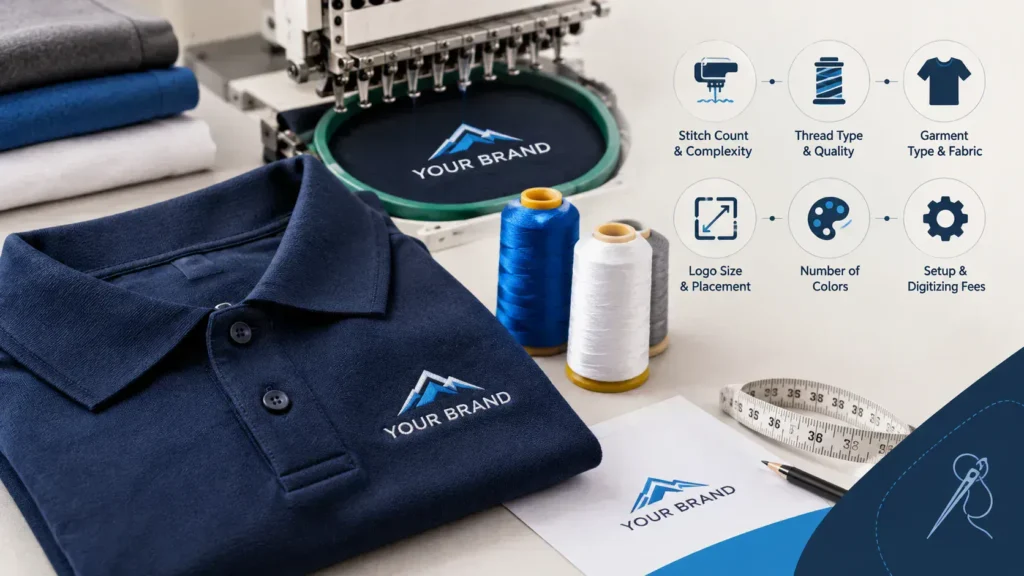
Embroidery cost per logo is the line most buyers skim past. It is a few dirhams a piece, so it looks like rounding. Then the invoice arrives and the branding is a fifth of the order, and nobody can explain why one logo cost three times what another did when they are the same size on the chest.
The reason is simple once you know it, and almost no supplier explains it up front.
Embroidery cost per logo is set by stitch count, not size
An embroidery machine charges you for time, and time is stitches. The industry quotes per thousand stitches. That is the unit on the machine, on the costing sheet, and on your invoice, even when the supplier only shows you a per piece figure at the end.
Physical size barely enters into it. A 60mm logo made of outlined letters might be three and a half thousand stitches. A 60mm crest with a solid filled background and fine detail can be fifteen thousand. Same width on the chest, four times the cost.
Not sure what your logo will cost to stitch?
Send the artwork and the finished size in millimetres. We will come back with the stitch count and a per piece price, usually the same working day.
Once you see the quote in stitches rather than in millimetres, the whole thing becomes predictable.
What pushes the stitch count up
Fill versus outline. This is the big one. A filled shape is the machine covering an area with thread, row after row. An outline is a line. Fill a background behind your logo and you can double the count without changing the look much from two metres away.
Small text. Letters below about 5mm need dense stitching to stay readable, and they often need to be enlarged or simplified instead. A tagline under the logo is usually the single most expensive element on a chest badge, and it is the element nobody can read anyway.
Detail that will not survive anyway. Gradients, thin strokes, drop shadows and tiny gaps all add stitches. Thread cannot do a gradient, so the digitiser approximates it with layered colours, and you pay for every layer.
Colour changes. Each thread colour is a stop on the machine. Most quotes build in a number of colours and charge beyond it. A six colour logo is not six times a one colour logo, but it is not the same either.
The setup fee nobody expects
Before anything is stitched, your artwork has to be digitised. That means somebody converts the logo into a stitch file, deciding the direction of every fill, the order of every colour, and how the fabric will pull as it goes.
It is a one time charge per design, not per garment. It is also the step that decides whether your logo looks right for the next three years, so it is the wrong place to shop on price.
Two things worth knowing. First, the file belongs to the design, not the garment, so reorders of the same logo should never carry it again. Ask for that in writing. Second, a logo digitised for a polo will not always behave on a jacket, because the fabrics pull differently. A second file is sometimes genuinely needed, and sometimes it is a way to charge twice.
What that looks like in practice
Three logos, all around 60mm wide, all going on the left chest.
| Logo | What it contains | Approximate stitches | Relative cost |
|---|---|---|---|
| A | Wordmark, outlined letters, one colour | 3,500 | 1.0x |
| B | Symbol with light fill plus name, two colours | 7,000 | 2.0x |
| C | Crest, solid filled background, small tagline, four colours | 15,000 | 4.3x |
Across three sets per employee and a hundred staff, that is three hundred applications. The difference between logo A and logo C on that order is not a rounding error. It is a budget line.
None of which means you should pick the plainest mark. It means you should know what the crest costs before you approve it, and that is a conversation to have while the artwork is still editable.
Embroidery, heat transfer or print
The cost question only makes sense next to how long each one lasts, because a branding method that fails is a garment replaced.
Embroidery is thread stitched into the cloth. It survives industrial laundry about as long as the garment does. It is the most expensive per piece and usually the cheapest over the life of the uniform.
Heat transfer is applied with heat and pressure. It is cheaper, it handles full colour artwork that embroidery cannot, and it is excellent on technical fabrics that a needle would damage. It also begins to lift at the edges after repeated industrial washing, often well before the garment is worn out.
Screen printing sits in between, cheap in volume and prone to cracking once the fabric has been through enough hot cycles.
The honest rule is that the wash decides. Garments going through a commercial laundry six days a week want thread. Garments washed at home or worn a handful of times want transfer or print. If you are not sure which side your program sits on, that is worth settling before the artwork is approved, and any decent embroidery services provider should be asking you about the laundry before they ask you about the logo.
Where buyers overspend
Branding every garment. A chef wears a jacket, an apron and a cap. Logos on all three is three applications per set. The jacket is the one people see.
Approving artwork before costing it. Marketing signs off the crest, procurement discovers the stitch count afterwards, and by then the brand guideline is fixed. Cost the artwork while it can still change.
Paying digitising twice. Reorders of the same logo on the same fabric should carry no setup. Check your second invoice against your first.
Ignoring position. A back logo is a larger area and a larger stitch count. Sleeves need hooping that slows the machine down. Position is a cost decision, not only a design one.
Choosing the method by price alone. The cheapest application on a garment that goes through industrial laundry is the one you pay for twice. This matters most on printed hi vis and technical fabrics, where the right choice is often not embroidery at all, and a workwear printing process is both cheaper and more durable than thread on that particular cloth.
What to send a supplier for a real quote
Four things, and you will get a number instead of a range.
- Vector artwork. AI, EPS or PDF. A screenshot or a JPEG means somebody has to redraw it, and you pay for that.
- The finished size in millimetres. Not “left chest”. The actual width.
- The garment and the fabric. Polo, jacket, coverall, hi vis. It changes the backing, the needle and sometimes the method.
- How it is washed. Commercial laundry or at home. This decides embroidery versus transfer before anything else does.
Then ask for the quote to show the stitch count. Any supplier running their own machines can tell you in a minute. One who cannot is buying the embroidery from somebody else, which is fine, but it means the price has a margin inside it you cannot see.
The question worth asking first
Not what embroidery cost per logo is in general. Ask what your logo costs at this stitch count, and what it would cost with the filled background removed.
That second number is usually a surprise, and on a three hundred piece order it tends to pay for the sample run.